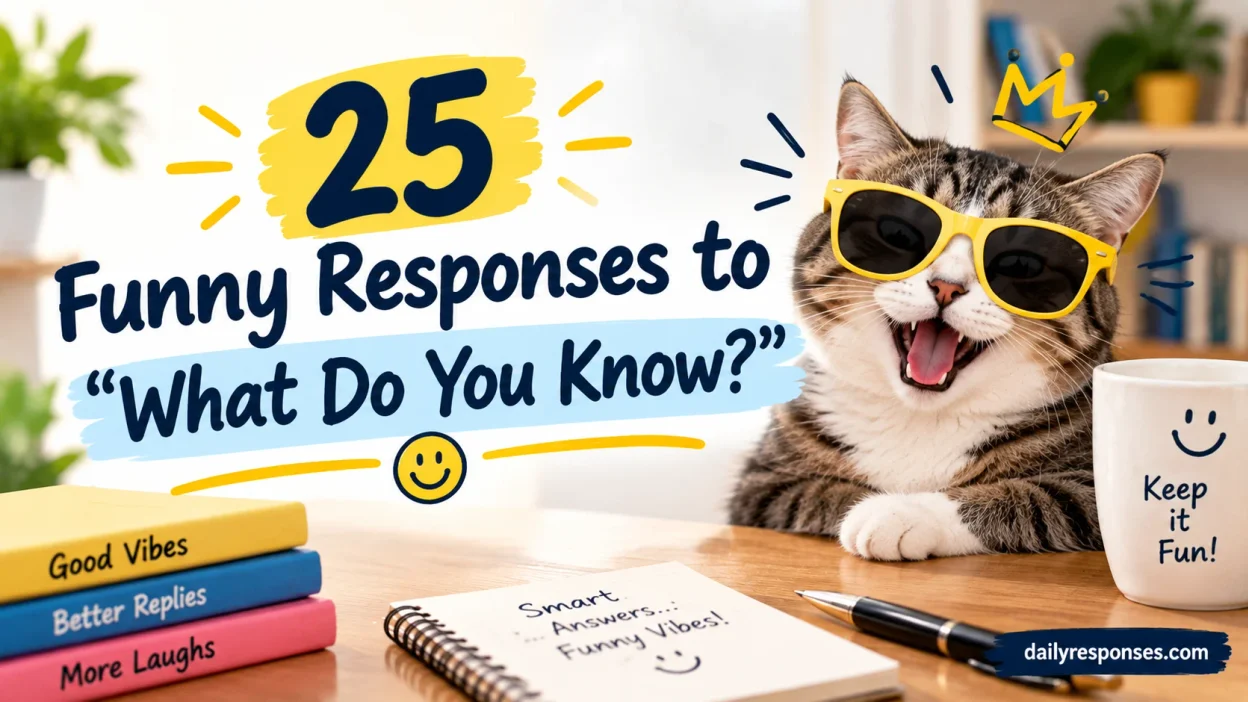
When someone casually asks “What do you know?”, Funny Responses to “What Do You Know?” can turn a simple question into a playful conversation and show your personality. A funny response works well when you match your words to the context and timing, especially with friends, coworkers, family, or someone online. Instead of giving a boring answer, you can use humor, wit, and a playful response to make the exchange more lively and interesting.
A clever one-liner, teasing response, or sarcastic one-liners can make people laugh, lighten the mood, and soften a serious moment. You can also use playful jokes, witty comebacks, or sarcastic comeback lines to surprise the questioner, create a shareable moment, and make the conversation memorable and enjoyable.
For a more absurd style, you could mention a unicorn in your fridge, shoelaces that rule another dimension, or a coffee mug that acts as a portal. Keeping a small stash of Funny Responses makes social interaction and communication easier because you already have the right response instead of searching at the last second. A natural, original, friendly, and safe answer can help you sound confident, humorous, and relaxed, while a little dash of humor can break the ice, show personality, and keep the chatting going.
Quick Answer:
If someone asks, “What do you know?” you can respond with something witty like, “Enough to know I probably shouldn’t answer that question.” Other funny replies include “I know everything Google hasn’t told me yet,” “That’s classified information,” or “I know you’re asking a dangerous question.”
Synonyms for : Funny Responses to “What Do You Know?”
- Enough to Be Dangerous
- I Know Things
- That’s Classified
- More Than I Should
- Google Knows More
- I Know Your Secrets
- I Know What You Did
- I Know Enough to Pass
- That’s Above My Pay Grade
- I Know Enough to Know Better
- I’m Basically Wikipedia
- I Know Nothing
- Wouldn’t You Like to Know?
- I Know Enough to Be Suspicious
- Ask Me Something Easier
- I Know Enough to Regret It
- I Have Sources
- Enough to Keep You Curious
- I Know What Matters
- Too Much, Probably
- That’s a Long Story
- I Know Enough to Survive
- Ask My Brain Tomorrow
- I Know Enough to Pretend
- More Than I’m Telling You
1. “Enough to Be Dangerous”
Scenario: Use this playful response when someone jokingly challenges your knowledge or expects you to reveal what you know.
Examples:
- “I know enough to cause trouble, but not enough to explain myself afterward.”
- “Just enough to be dangerous and absolutely confident about it.”
- “I know enough to make questionable decisions with impressive confidence.”
Explanation: This response creates a playful sense of mystery while pretending your knowledge could cause trouble. It works especially well among friends because it sounds confident, humorous, and intentionally exaggerated without becoming rude or overly serious.
2. “I Know Things”
Scenario: Try this simple comeback when you want to sound mysterious while keeping the conversation lighthearted.
Examples:
- “I know things, important things, and occasionally things I immediately forget.”
- “I know things you probably aren’t emotionally prepared to hear today.”
- “I know things, but unfortunately, most of them are completely useless.”
Explanation: “I know things” sounds deliberately vague, which makes it funny because the listener expects a specific answer. Adding a playful twist turns an ordinary statement into a confident, mysterious, and memorable comeback.
3. “That’s Classified”
Scenario: Use this humorous answer when someone asks what you know and you want to pretend your information is highly secret.
Examples:
- “That information is classified, and I definitely cannot discuss it over snacks.”
- “Sorry, that information requires three passwords and a secret handshake.”
- “I could tell you, but then this conversation would become extremely complicated.”
Explanation: Calling ordinary information “classified” makes the situation funny through exaggeration. It works particularly well when everyone knows there is no real secret, allowing you to create playful mystery without making the conversation uncomfortable.
4. “More Than I Should”
Scenario: Say this when you want to tease someone by suggesting you know something they probably hoped you didn’t.
Examples:
- “Honestly, I know more than I probably should about this situation.”
- “I know enough to make this conversation surprisingly awkward for everyone involved.”
- “Let’s just say I know things that could become tomorrow’s gossip.”
Explanation: This comeback creates curiosity while gently teasing the other person. It suggests hidden knowledge without actually revealing anything, making it useful when you want to keep the conversation playful, mysterious, and slightly dramatic.
5. “Google Knows More”
Scenario: Use this response when you want to admit you are not the ultimate expert while still making the answer funny.
Examples:
- “Google knows more, but I have better storytelling skills than Google.”
- “I know enough to search Google confidently when things get complicated.”
- “Google probably knows everything, but somehow I still get asked.”
Explanation: This response uses everyday technology as the punchline. Since people commonly search for answers online, comparing your knowledge with Google creates an easy, relatable joke that feels casual rather than overly rehearsed.
6. “I Know Your Secrets”
Scenario: Try this playful comeback with a close friend when harmless teasing fits your relationship.
Examples:
- “I know your secrets, but luckily, I’m accepting bribes in chocolate.”
- “I know enough of your secrets to negotiate better friendship benefits.”
- “Your secrets are safe with me, assuming snacks continue arriving regularly.”
Explanation: This response works through playful exaggeration and friendly teasing. It should be used with people who understand your humor, because mentioning secrets can sound serious without the right relationship or conversational context.
7. “I Know What You Did”
Scenario: Use this dramatic response when you want to make an ordinary conversation suddenly sound like a mystery movie.
Examples:
- “I know what you did, and honestly, your explanation better be entertaining.”
- “I know what happened, but I’m waiting for your dramatic confession.”
- “I know everything, detective mode activated and absolutely no evidence available.”
Explanation: The humor comes from suddenly treating a normal situation like an investigation. Your dramatic delivery makes the response funny, especially when there is obviously nothing serious happening behind the exaggerated accusation.
8. “I Know Enough to Pass”
Scenario: Say this when someone questions your knowledge and you want to answer with relaxed, self-deprecating humor.
Examples:
- “I know enough to pass the test, but definitely not enough to teach it.”
- “I know enough to survive, which honestly feels like academic success.”
- “I know enough to sound smart for approximately five minutes.”
Explanation: This response pokes fun at your own knowledge without putting yourself down too harshly. It feels relatable because most people have experienced knowing enough for something without considering themselves an expert.
9. “That’s Above My Pay Grade”
Scenario: Use this classic workplace-style joke when someone asks you something complicated or unexpectedly serious.
Examples:
- “That question is definitely above my pay grade, so I’m officially unavailable.”
- “Sounds important, but unfortunately my imaginary salary doesn’t cover that responsibility.”
- “I’d answer, but my contract specifically forbids unnecessary thinking today.”
Explanation: The joke comes from pretending that answering the question requires a higher salary or professional rank. It keeps your response light while giving you an amusing excuse for not having an answer.
10. “I Know Enough to Know Better”
Scenario: Use this confident response when someone asks what you know and you want to sound experienced.
Examples:
- “I know enough to recognize trouble before it starts knocking.”
- “I know enough to know better, although I occasionally ignore that knowledge.”
- “Experience taught me plenty, but apparently common sense needs reminders.”
Explanation: This response combines confidence with self-aware humor. The final twist acknowledges that knowing better does not always mean behaving perfectly, making the comeback feel human, relatable, and easy to use.
11. “I’m Basically Wikipedia”
Scenario: Say this jokingly when you want to exaggerate your knowledge without seriously claiming to know everything.
Examples:
- “I’m basically Wikipedia, except my sources are mostly questionable memories.”
- “Ask me anything; I’m Wikipedia with significantly fewer reliable references.”
- “I know plenty, although fact-checking me might become necessary afterward.”
Explanation: Comparing yourself to Wikipedia creates an exaggerated image of knowledge. The joke becomes stronger when you admit your information may need checking, making the response confident while remaining obviously playful.
12. “I Know Nothing”
Scenario: Use this humorous contradiction when someone expects you to know something and you want to playfully deny everything.
Examples:
- “I know absolutely nothing, and somehow that hasn’t stopped me before.”
- “Nothing useful, unfortunately, but I have plenty of opinions.”
- “I know nothing, yet somehow everyone keeps asking me questions.”
Explanation: Pretending to know nothing creates humor through exaggeration and irony. It is especially effective when people already know you understand the subject, making the dramatic denial obviously playful rather than genuinely defensive.
13. “Wouldn’t You Like to Know?”
Scenario: Try this teasing reply when someone is being curious and you want to make them work for the answer.
Examples:
- “Wouldn’t you like to know? Unfortunately, curiosity comes with no free answers.”
- “Wouldn’t you like to know? Maybe I’ll reveal everything after dessert.”
- “Wouldn’t you like to know? Keep guessing; watching you struggle is entertaining.”
Explanation: This classic teasing phrase turns the question back onto the person asking it. It creates playful suspense and works best when delivered with a smile so the other person understands you are joking.
14. “I Know Enough to Be Suspicious”
Scenario: Use this response when something seems strange and you want to joke about your detective instincts.
Examples:
- “I know enough to be suspicious, but not enough to file paperwork.”
- “Something feels suspicious, and unfortunately, my detective instincts agree.”
- “I know enough to ask questions, dramatically raise eyebrows, and investigate snacks.”
Explanation: This comeback turns ordinary curiosity into a pretend investigation. Mentioning detective behavior adds humor while keeping the response flexible enough for friends, casual conversations, and situations where something simply seems unusual.
15. “Ask Me Something Easier”
Scenario: Say this when you want to admit you are unsure without making the conversation awkward.
Examples:
- “Ask me something easier, like why I opened the refrigerator again.”
- “Can we start with something simple, preferably involving snacks?”
- “That question feels advanced; do you have a beginner-level version?”
Explanation: This response makes uncertainty funny instead of uncomfortable. By comparing the question to an advanced test, you turn not knowing something into a lighthearted moment that keeps the conversation relaxed.
Read More : 25 Best Responses to Someone Playing You
16. “I Know Enough to Regret It”
Scenario: Use this playful answer when you know something embarrassing, complicated, or unnecessarily dramatic.
Examples:
- “I know enough to regret asking, listening, and remembering everything.”
- “Unfortunately, I know too much, and ignorance suddenly sounds peaceful.”
- “I know enough to wish someone had stopped me earlier.”
Explanation: The humor comes from treating knowledge like an unfortunate burden. It works well when a situation has become complicated, embarrassing, or dramatic and you want to acknowledge that without sounding overly serious.
17. “I Have Sources”
Scenario: Use this dramatic comeback when someone doubts your information and you want to pretend you have secret evidence.
Examples:
- “I have sources, questionable sources, but technically sources nonetheless.”
- “My sources are confidential, mostly because they might be completely imaginary.”
- “I have sources, and they strongly recommend ordering pizza immediately.”
Explanation: Pretending to have secret sources gives an ordinary answer a dramatic news-report feeling. Adding an obviously silly detail keeps the joke clear and prevents the response from sounding like a serious accusation.
18. “Enough to Keep You Curious”
Scenario: Try this charming response when you want to sound mysterious without revealing everything immediately.
Examples:
- “I know enough to keep you curious, which is probably more entertaining.”
- “Just enough information to keep this conversation interesting for everyone.”
- “I know enough to make you ask another question, apparently.”
Explanation: This response creates playful mystery without sounding aggressive. It encourages the other person to continue the conversation while making your limited answer feel intentional, confident, and slightly mischievous.
19. “I Know What Matters”
Scenario: Use this thoughtful but funny response when you want to shift attention away from unnecessary details.
Examples:
- “I know what matters: good friends, good food, and excellent Wi-Fi.”
- “I know what matters, and honestly, snacks rank surprisingly high.”
- “I know what matters, although remembering passwords remains challenging.”
Explanation: This response mixes a meaningful idea with a silly everyday detail. It works because the first part sounds serious while the unexpected ending keeps the answer humorous, casual, and memorable.
20. “Too Much, Probably”
Scenario: Say this when someone asks what you know and you want to give yourself a funny, exaggerated reputation.
Examples:
- “Probably too much, especially considering nobody asked me to investigate.”
- “Too much, honestly, and somehow I still forget important birthdays.”
- “I know too much and remember exactly the wrong details.”
Explanation: This answer humorously contrasts having plenty of knowledge with forgetting ordinary things. That contradiction makes the response relatable while giving you a confident and playful way to handle the question.
21. “That’s a Long Story”
Scenario: Use this response when you want to make your answer sound dramatically complicated, even when it really is not.
Examples:
- “That’s a long story, and unfortunately, there’s no intermission.”
- “That’s a long story involving snacks, bad decisions, and questionable timing.”
- “I could explain, but we might accidentally miss tomorrow.”
Explanation: Calling a simple answer a “long story” creates playful drama. Adding ridiculous details makes the response more entertaining and gives the other person a reason to laugh rather than expecting an actual lengthy explanation.
22. “I Know Enough to Survive”
Scenario: Try this humorous response when someone asks about your general knowledge, skills, or ability to handle a situation.
Examples:
- “I know enough to survive, which is currently my strongest qualification.”
- “I know enough to survive and confidently avoid unnecessary complications.”
- “Survival knowledge? Plenty. Adulting knowledge? Still under construction.”
Explanation: This comeback uses everyday struggles as the joke. Saying you have enough knowledge to survive feels exaggerated but relatable, especially when discussing adulthood, work, school, responsibilities, or complicated everyday situations.
23. “Ask My Brain Tomorrow”
Scenario: Use this funny answer when you know your brain is not cooperating right now.
Examples:
- “Ask my brain tomorrow; apparently today it’s operating on airplane mode.”
- “My brain knows the answer, but it’s currently unavailable.”
- “Try again later; my remaining brain cells are having a meeting.”
Explanation: Personifying your brain makes the response instantly playful. Comparing it to airplane mode or a meeting gives you an amusing way to explain forgetfulness, tiredness, or temporary confusion without making the moment uncomfortable.
24. “I Know Enough to Pretend”
Scenario: Say this when you want to poke fun at confidently acting knowledgeable about something.
Examples:
- “I know enough to pretend confidently, which has worked surprisingly well.”
- “I understand approximately seventy percent, but confidence covers the rest.”
- “I know enough to nod wisely and avoid difficult follow-up questions.”
Explanation: This response uses self-deprecating humor to acknowledge that confidence can sometimes look like expertise. It is especially relatable in casual conversations where nobody expects a serious professional-level answer.
25. “More Than I’m Telling You”
Scenario: Use this playful final comeback when you want to sound mysterious and leave the other person wondering.
Examples:
- “I know more than I’m telling you, but I enjoy keeping things interesting.”
- “There’s plenty I could reveal, but where would the fun be?”
- “I know more than you think, and that’s all you’re getting today.”
Explanation: This response creates mystery while keeping the mood playful. It works especially well with friends who enjoy teasing because it suggests hidden knowledge without actually making a serious claim or creating unnecessary tension.
FAQs:
1. What does “What do you know?” mean?
“What do you know?” can be a genuine question about your knowledge, but it can also be used for small talk, teasing, or starting a playful conversation. The meaning often depends on the person, context, and tone.
2. What is a funny response to “What do you know?”
A funny response can be a clever, silly, or sarcastic line that makes the conversation more enjoyable. For example, you could say, “I know my coffee mug has secrets it refuses to share.”
3. How can I respond sarcastically to “What do you know?”
You can use a light sarcastic comeback that sounds playful rather than rude. A line like, “Enough to know I probably shouldn’t tell you everything,” can create humor while keeping the conversation friendly.
4. Can I use these responses with friends?
Yes. Funny responses work especially well with friends because you can usually be more playful and informal. Choose a response that matches your friendship and avoid jokes that could accidentally sound insulting or overly personal.
5. How do I choose the right funny response?
Think about who is asking, the context, and the mood of the conversation. A short joke may work in casual chatting, while a clever or sarcastic response may fit better when someone is clearly teasing you.
Conclusion:
“What do you know?” doesn’t always need a serious answer. With the right humor, timing, and playful response, you can turn an ordinary question into a memorable exchange.
Whether you choose a clever one-liner, sarcastic comeback, silly joke, or completely absurd answer, make sure it fits the person and situation.
A natural response can help you show personality, break the ice, and keep the conversation enjoyable.

Muhammad Haroon is the author of DailyResponses.com, where he writes practical guides, clever responses, and communication tips. His mission is to help readers express themselves with confidence through natural, engaging, and easy-to-understand content.
[…] Read More : 25 Funny Responses to “What Do You Know?” […]